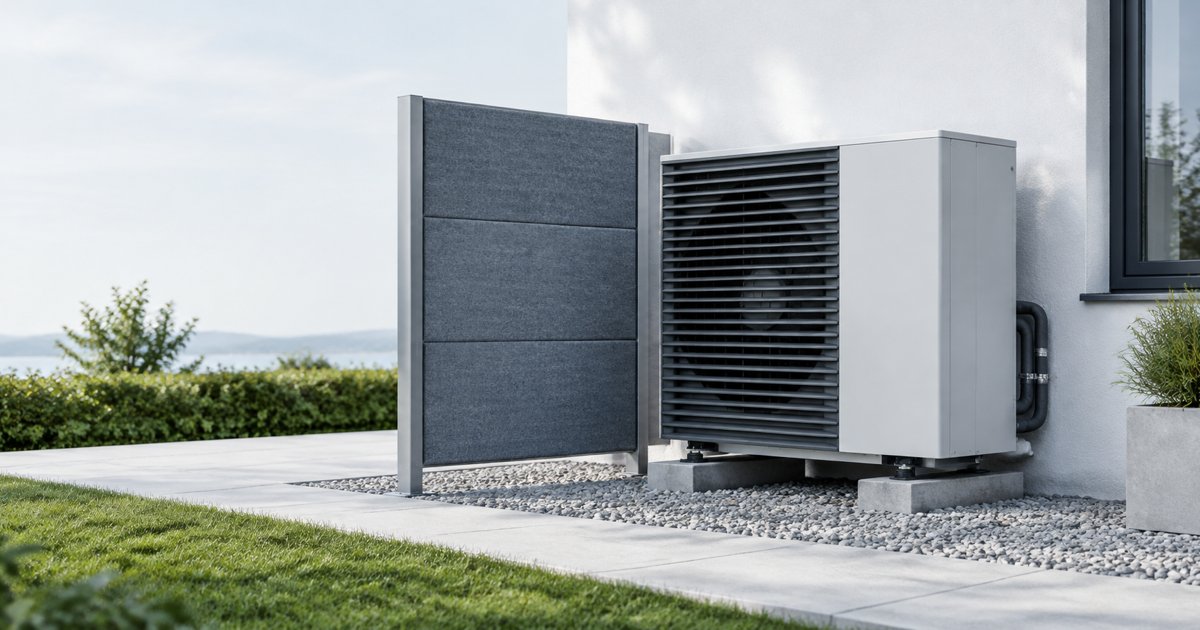
Will your outdoor unit meet the noise limit at your neighbour's window?
Enter an air conditioner, heat pump, chiller or air handling unit and the location where your neighbour lives. We will calculate the noise at their window, compare it with the limit and show what will help: a barrier, louvres or an enclosure.
For designers: octave-band calculation according to ISO 9613-2, limits for Slovakia, Czechia and Austria
For owners and property managers: a clear answer on whether the unit complies, with no specialist knowledge required
Free, no registration, instant results
Example calculation, night-time 22–6 hA chiller and two heat pumps on the roof, neighbour's window 25 m away
Without mitigation51,7 dB(A)Limit exceeded by 6,7 dB
With a panel barrier40,5 dB(A)Complies, with a margin of 4,5 dB
Limit 45 dB(A). The barrier reduces noise by 11 dB, which we perceive as roughly half as loud.
HvacCheck calculator calculation: a chiller at 85 dB(A) and two heat pumps at 72 dB(A) each, a 3 m high barrier made of Akustik 100P panels, a limit according to the Slovak decree, including a calculation uncertainty of 3 dB. Indicative calculation; not a substitute for a noise assessment.
The manufacturer specifies the unit's noise. Your neighbour cares about the noise at their window.
The technical data sheet lists the sound power level Lw. It tells you how much noise the unit emits, not how much is audible 20 metres away. Compliance with limits is assessed at the window of a protected room, where sound pressure is the determining factor.
Between those two figures are the distance, the unit's position and everything in the way: a parapet, a neighbouring building or a barrier. The calculator accounts for these separately for each frequency band, because low-frequency sounds travel around obstacles more easily than high-frequency sounds.
Each doubling of distance reduces the level by 6 dB. A reduction of 10 dB is perceived as roughly half as loud.
How much distance alone reduces noiseA unit with a sound power level of 85 dB(A), freely positioned on a roof with no obstructions
5 m
63 dB(A)
10 m
57 dB(A)
20 m
51 dB(A)
40 m
45 dB(A)
80 m
39 dB(A)
Half-space propagation without atmospheric absorption or calculation uncertainty. The night-time limit outside an apartment window is 45 dB(A) in Slovakia and 40 dB(A) in Czechia.
Five options for the same roofNoise at the neighbour's window, limit 45 dB(A)
Without mitigation51,7 dB(A)
3 m louvred barrier42,4 dB(A)
3 m panel barrier40,5 dB(A)
Panel enclosure with louvres31,3 dB(A)
Standard enclosure for each unit28,3 dB(A)
HvacCheck calculator results for the configuration in the introductory example. Akustik 100P panels, Stavoklima PHZE 300 louvres, Silentbox standard enclosure.
Ways to reduce noise
The same unit, five different results
A barrier only works if it blocks the direct line of sight from the window to the unit. Sound must then travel over its top edge and around its ends. The higher the barrier and the closer it is to the unit, the greater the reduction.
Louvres allow air to pass through, so they provide slightly less attenuation than a solid panel. An enclosure surrounds the unit on all sides and usually provides the greatest reduction, but it requires openings for air intake and discharge.
The calculator compares all options side by side and shows how noise reaches the window in each case: over the top edge, around the ends or through the structure itself.
Requirements to meet
How many decibels the regulations allow
Each country has its own limits and time periods. Night-time is usually the deciding factor, as this is when the limit is strictest and units are often running. The calculator compares the result with the selected limit and indicates how many decibels of additional reduction are needed or how much margin remains.
Outside an apartment window
Slovakia
Czechia
Austria
Day
50 dB (6–18 h)
50 dB (6–22 h)
depending on the area category
Evening
50 dB (18–22 h)
included in daytime
depending on the area category
Night
45 dB (22–6 h)
40 dB (22–6 h)
depending on the area category
Noise with a prominent tone
5 dB is added to the result
the limit is 5 dB lower
subject to assessment
Slovakia: under Decree of the Ministry of Health of the Slovak Republic No. 549/2007 Z. z., area category II, noise from other sources. Czechia: under Government Regulation No. 272/2011 Sb., protected outdoor areas of buildings. Austria: based on ÖNORM S 5021 and the regulations of the federal states; values vary by federal state and area type. The calculator offers all categories.
Surrounding buildings both screen and reflect noise. The calculator loads an elevation model of the area, identifies buildings and vegetation within it, and displays them on the map and in 3D.
Position units, windows and the barrier by clicking on the map
The calculation accounts for screening by buildings, diffraction around their corners and reflections from façades
The noise map shows where noise spreads and where the barrier creates an acoustic shadow
Without a map, simply enter the distance and heights manually
Illustration of the principle. In the calculator, the map is calculated using an elevation model and your units.
Practical examples
Four common scenarios
The values are calculated by the same calculator that you can open yourself. All apply to nighttime in Slovakia with a limit of 45 dB(A) and include a calculation uncertainty of 3 dB.
Heat pump at a detached house
One unit rated at 60 dB(A) next to the house wall, neighbour's window 6 m away
Without mitigation40,4 dB(A)
Margin below the limit4,6 dB
Complies even without noise control measures. That is a useful result too: the calculator shows when neither a barrier nor an enclosure is needed.
Air conditioning for an apartment building
Three VRF units rated at 72 dB(A) each on the roof, neighbour's window 15 m away
Without mitigation47,3 dB(A)
With a 2,5 m barrier35,7 dB(A)
Without a barrier, the limit is exceeded by 2,3 dB. A barrier just 1,8 m high would meet the limit.
Cooling for an office building
Chiller rated at 85 dB(A) and two heat pumps, neighbour's window 25 m away
Without mitigation51,7 dB(A)
With a 3 m barrier40,5 dB(A)
Without a barrier, the limit is exceeded by 6,7 dB. With a 3 m high barrier, a margin of 4,5 dB remains.
Ventilation equipment on a shop roof
Rooftop unit rated at 82 dB(A), neighbour's window 30 m away, below roof level
Without mitigation46,7 dB(A)
With a 3 m barrier34,2 dB(A)
Without a barrier, the limit is exceeded by 1,7 dB. A barrier just 2,1 m high would meet the limit.
Manually entered distances and heights, with no surrounding buildings. Barriers made from Akustik 100P panels stand 1,5 to 2 m from the units. The unit spectra are typical for each type; the actual unit may differ.
How it works
Three steps to an answer
1
Enter the units
Unit type, sound power level from the technical data sheet and number of units. If you have octave-band data, enter the full spectrum.
2
Mark the neighbour's window
Enter the distance and height manually or by clicking on the map showing buildings. Select the country, area type and time of day.
3
View the result
Noise at the window, margin below the limit, comparison of noise control options, bill of materials and a downloadable report.
Who it is for
Check the noise before installing the unit
Ventilation and cooling designersQuickly check unit locations during the design stage.
Air conditioning and heat pump suppliersSupporting documentation for a quotation and justification for correct positioning.
Architects and developersWhere to position rooftop units without disturbing neighbours or apartments in the same building.
Building owners and managersWhat helps when a neighbour complains about noise from a unit.